Saturday, May 21, 2016

Please - don't draft a kicker early

My brother (@EaglesRewind) commented on the other day about this tweet, referring to the Tampa Bay Buccaneers drafting strategy:


The Bucs reportedly had a first-round draft grade on kicker Roberto Aguayo, who they actually drafted in the second round of this year's draft.

So under their logic, the Bucs got a steal by snagging a kicker in the second round!

This almost made my head explode - and then I read this article which evaluates whether the Raiders 2000 drafting of Sebastian Janikowski in the first round was a good idea or not.

The article doesn't come down one way or the other, the writer sees both sides of the 'debate.'

That did actually make my head explode.

I wanted to dig into it - and I did - and the answer is Janikowski pick was NOT a good one.

Now, I don't have to waste time talking about the case against drafting a kicker (even one as successful as Janikowski) in the first round. Anyone who's reading this blog is likely already familiar with all those thoughts (e.g., massive opportunity cost to pick at a low-value position). So we'll focus instead on the arguments 'for' drafting a kicker high.

The primary argument I've seen, is that Janikowski has been a good kicker for so long, that he was worth the investment. He played from 2000 to 2015 -- which is admittedly an absurdly long career for the NFL.

And when someone wants to make that argument, they'll point to something like PFR's Approximate Value metric. And it's true, Janikowski generated an career approximate value of 53 in aggregate across his career. The average of all other first round picks output from 2000 through 2015 is only 50 in career approximate value (this includes seasons when these players didn't play).

OK, by only that one measure, you could argue Janikowski was worth it -- but it's tremendously flawed logic, because it ignores one simple idea.

The time value of 'approximate value'

There's never any talk about a discount rate for this value, and that ignores the reality that performance generated for the team today is much more valuable than performance generated 15 years from now.

Talking about discount rate is usually reserved for financial discussions - but it's pretty straightforward. What's worth more to you, a dollar today or a dollar given to you in fifteen years?

It's also the reason why a general NFL draft rule of thumb is trading for a draft pick this year will cost you a pick in a higher round next year.

So if anyone claims that Janikowski was a good pick -- it's because they effectively have a discount rate of practically zero.

I'll show you.

I took data from the first round of the 2000 NFL draft - including approximate value generated by year by player. First, let's look at cumulative AV generated by Janikowski over his career vs. every other player in the first round.


You'll notice that Janikowski starts off behind and the gap grows very quickly - until it's highest point in 2008. Keep in mind the average of all first round picks includes both those who played well (Brian Urlacher, Career AV of 118) and those who, well, didn't (R. Jay Soward, Career AV of 2). For the first nine years in the league, that non-Janikowski average pulled away from the Raiders kicker.

That's because, as you'd expect, Kickers don't generate a ton of value by themselves. But in the world where you're trying to rationalize taking a kicker first, you'll point out that because kickers can play forever (and the Raiders happened to find a good one), that eventually Janikowski matches and passes his first round peers by 2015.

That's great, but we're evaluating a decision made in 2000. So if you were back at the draft in 2000, fresh off a sigh of relief that Y2K computer malfunctions didn't make all our planes drop out of the sky, and if you had perfect information on how Janikowski and his peer group would perform, would you still make the pick?

That's where the discount rate comes in.

Now the typical NFL discount rate seems like it would be pretty high. The NFL is a win-now league and most QBs/Coaches/GMs don't keep their jobs past a few years. That means you'd willing to give up a lot of future value for production today. No one (at least that I've seen) has put a good handle on it, but it's a relatively high number.

In the corporate world, you typically have a longer time horizon and things are a bit less focused on immediate return. Often you'll see discount rates between 10-20% for the valuation of internal projects (though of course, this can vary)

So, what I thought would be helpful is to run scenarios and see what discount rate you'd need to have in order to make Janikowski's long term AV return 'better' than his peers. If that was your personal discount rate as an NFL GM, you'd be thrilled to take Janikowski. If your personal discount rate is higher, you'd want to take the peer group, who will generate more value sooner, which is what you want.

Below is an illustration of the valuation curves for Janikowski and all the other first round picks averaged together.


Just to clarify, these 'valuations' are basically how much AV it's worth on draft day in 2000, given a varying discount rate.

If you squint, you'll barely be able to see the point at which the Janikowski curve crosses the peer group curve. Because once your discount rate exceeds 1.6%, the peer group average is worth more to you.

The only situation where you'd ever value Janikowski more than the rest of his draft group is if you have a discount rate extremely close to zero.

The implication here, to me, is that if you took a time machine and with all of today's data went back to the Raiders draft room in 2000, you would never make this pick again (you'd probably take Tom Brady instead).

And so when I see the Bucs take a kicker in the second round, and I try to think through their case that it's not an idiotic decision, I just can't do it. You basically have to assume that Aguayo will play as long as Janikowski, be significantly better than Janikowski, or you have to have a discount rate so small you must be planning to hold your GM job for the next 15 years.

Call me skeptical.

Friday, May 6, 2016

Do Small School QBs Underperform?

Welcome to the Carson Wentz era!

Now that the Eagles draft is behind us, we can start thinking about what's in store for us in the future.

The Eagles have a shiny new QB in North Dakota's Carson Wentz -- and while they still haven't figured a way out of the messy situation San Bradford has created (yes, I'm putting the blame on him), that shouldn't stop us from wondering what a Wentz' led Eagles team could look like.

I have to admit, I wasn't following all the pre-draft hype that closely, but once the Eagles moved up and were in a position to draft Wentz, I started wondering about one specific narrative that would obviously become attached to him.

Wentz played at North Dakota State, which is about as far away from a college football powerhouse as you can get unless your college has the word 'barber' or 'clown' in front of it.

I'll be honest, that concerned me. Would Wentz be at a significant disadvantage because he played in college football's lower level?

My first thought was that this will be easy - let's just look and see all the other lower division quarterbacks that have been drafted and see how they've done.

Only problem...look at this list

That's a link to all non D-1 quarterbacks drafted over the last twenty years.

You'll notice that only one lower level QB in 20 years has been drafted in the first round. Joe Flacco.

Not exactly a robust set of comps. It felt very unsatisfying.

But then I had a thought, that just looking at D-1 vs. non-D-1 QBs might be to strong of a distinction.

What I'm trying to see is whether quarterbacks at lower level football programs perform disproportionately better or worse than those who play at higher level programs. It's easy to see why the narrative might logically apply -- a higher level program is one with more pressure, more fans, more talented athletes -- so it seems plausible that QBs exposed to that crucible and perform well are more likely to succeed in the NFL than those who don't (and ostensibly, might not have their weaknesses exposed).

Yet, D-1 vs. Non-D-1 QBs is only one way to get at that distinction - it's a binary one and as we can see, there are near zero observations.

So we need another basis for comparison to measure how 'big-time' a college football program is.

What I thought would be just as good of an indicator of how 'big-time' a college football program is, is the capacity of its football stadium.

A college with 100,000 fans in the bleachers every Saturday is going to be one with a lot of exposure, pressure, and talent.

A college with 20,000 fans in the bleachers, is going to have less of all of those things.

If we use that capacity as our metric, all of a sudden we have a much broader set of observations -- you can play at a small school in the highest level of college football (e.g., Tulane, which has a capacity of only 30,000). Now those small stadium teams may still play against better competition -- but we have to use what we can.

I'd argue that going a QB from Tulane might be better compared to other small school QBs than a QB who played at Notre Dame or USC.

So I took every quarterback, from all schools, drafted in the first round since 2000, and charted them on two dimensions:

1 - The capacity of their college football stadium (thanks Wikipedia)
2 - Their career Approximate Value (Pro-Football-Reference's stat) per Game

If highly drafted quarterbacks from small schools (e.g., Carson Wentz) are more likely to underperform, we'd expect to see QBs from smaller schools have a lower approximate value, while the QBs from football factories will outpace them once they get to the NFL.


That red line is the trendline, which shows a slight negative correlation. Across our 41 quarterbacks, the data does not suggest that those from smaller schools are any worse than those from big schools. If anything, it suggests the opposite might be true.

Now this isn't a perfect methodology, but it's enough for me to feel comfortable that smaller school QBs don't clearly have a handicap relative to guys from bigger schools. But you'll also notice that the sample size of small school QBs is small -- like REALLY small.

Carson Wentz's stadium at North Dakota St. has a capacity of only 18,700, smaller than any QB drafted that high since 2000. The only guys even really close are the aforementioned Flacco and Big Ben (Miami of Ohio had a capacity of under 25k).

Even if you go back 40 years - you only have a few more first rounders from small schools.

Steve McNair - 1995 (Alcorn State)
Ken O'Brien - 1983 (Cal-Davis)
Phil Simms - 1979 (Morehead State)

So while the data suggests there's not an inherent issue with small school QBs taken in the first round, these cases just don't come along very frequently. There have been six (including Wentz) in the last 40 years.

Of course, looking across that list, all but O'Brien led their teams to at least one Super Bowl appearance.

So we got that going for us, which is nice.


Sunday, April 24, 2016

Should Rookie QBs Start Right Away?

Anyone remember an Eagles off-season where they didn't make headlines?

Howie Roseman and company just set off a massive trade bomb, exchanging a bounty of current and future draft picks with the Cleveland Browns in exchange for the second overall pick in the draft -- which the team will use on a quarterback.

Now let's ignore which of the top quarterback prospects the Eagles are going to take -- and let's focus on the choice the Eagles will have to make after they draft in the highest slot since they took that guy from Syracuse.

Should they start the rookie?

Now we know what Roseman has indicated they'll do. It appears the Eagles will keep Sam Bradford and Chase Daniel and let them be the primary quarterbacks this year (Sam Bradford's rumored trade demand notwithstanding).

But that's not our question -- our question is what SHOULD the Eagles do with their newly drafted first round QB?

I was having this debate over email with friends -- is it better to start a rookie QB right away or to sit him for a year. We were talking pros and cons of the two approaches, but kept reaching for standard QB narrative tropes -- that sitting would let him learn, avoid bad habits, etc.

We've heard all these things before. There are people who would say that rookies really benefit from time to 'learn the speed of the NFL game.' There are others who would argue the best way to learn the game is to actually play it. Both the sit and wait camp (look what happened to David Carr) and the start them right away (Andrew Luck is good!) have tons on anecdotes to throw around.

But no one really looked at the data -- and some brief google searches didn't scratch my itch -- so I thought we should fix that.

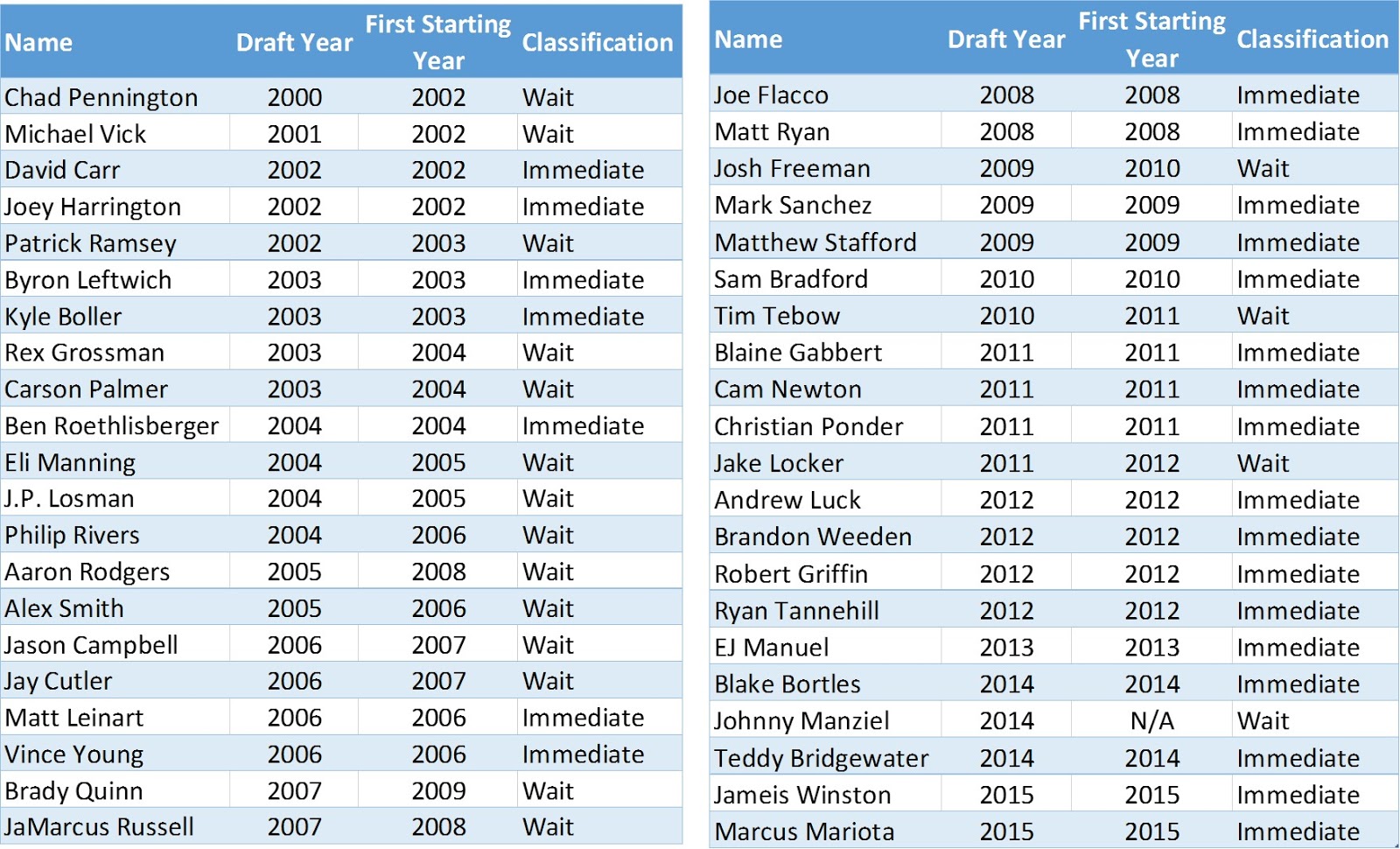
I pulled together data from all first round quarterbacks drafted since 2000, and looked across each of them to identify the first year they truly became 'starting quarterback.' That distinction is based on playing time (if you started most of your team's games) and media reports on when quarterbacks were named starter going into the season.

We have have two groups -- guys who started immediately and guys who had to wait. With that distinction, we can compare how they performed and see if either group is distinctly outperforming the other. The implications could suggest how the Eagles SHOULD handle their new QB of the future.

Results

We have 42 quarterbacks in our sample -- and the split is roughly 60/40 -- 24 of those quarterbacks started immediately and the remaining 18 took over the job some year(s) after their rookie season. Below is a table of our QBs and how they were defined:


I pulled in a whole slew of performance metrics compared the two groups. And what's key in comparing the two groups of QBs to each other is lining up their first starting years with each other. It makes no sense to compare the rookie years of both groups when one didn't play. So in our analysis, you'll see I aligned all the quarterbacks around their respective First Starting Year - the first season where they were their team's starting QB.

If you'd argue that sitting a rookie quarterback for a year or more to acclimate to the NFL would be beneficial, then we should see some outperformance either in that First Starting Year or in their career performance trajectory.

Below are illustrations of average performance of those QBs who started immediately after being drafted (orange) and those who had to wait (blue). There are three charts, the first is using QB rating, the second is using Passing Yards per Attempt, and the third is using Pro-Football-Reference's Approximate Value metric. See if you notice a pattern.


In looking across all these metrics -- I wasn't able to identify any clear outperformance by quarterbacks who waited to get their job. Across all the variables, the guys who wait extra year(s) perform pretty much just as well as the guys who start right away.

Also - you don't see any significant trajectory changes over time - by that I mean the guys who wait don't get any kind of long-term performance advantage in doing so.

The only difference I could really see was in their ages (obviously). QBs starting immediately are on average, 22.8 years old. QBs who wait, they're 24.1 when they get the job. It just doesn't appear as though there's any difference beyond a slight age gap.

Implications

This data would suggest that all that time riding the pine isn't really worth it for the QB's ultimate performance. They sit, they go to meetings and practices, but once they actually start they do just about as well as the guys who are thrown right into the fire.

Now, if we were in college and debating the merit of red-shirting freshmen quarterbacks, there's really not much downside to having the prospect wait. College players have a defined window of eligibility and cannot play beyond it. But NFL rookie QBs have much longer potential tenures, and they start their careers on fixed contract terms with clocks that tick even when they don't play.

If you're a college coach, redshirting a quarterback means you'll still get four years of performance, you just need to wait one year.

If you're an NFL GM/coach and you have a first round rookie quarterback, that quarterback is on a fixed four-year contract (five with a team option). If you bench that quarterback for a year, that contact becomes a three-year deal with an option. Benching him does come at a cost - because that's one less year on his rookie deal.

If you keep a quarterback on the bench for a year and he turns out to be a superstar, well then you've wasted a year of his term. If he's a bust, then it's kind of a moot point because you're probably going to lose your job regardless.

What's particularly interesting is that the NFL may have figured this out.

Below is an illustration of all the QBs in our sample by draft year. They're split across our two buckets, those who waited to start and those who started immediately. See if anything jumps out at you.


The practice of benching a rookie first round quarterback for a year or more to learn the ropes has declined noticeably since 2000. Before 2008, only one-third of first round QBs started right away. Since 2008? About 80% of them have started immediately.

It's now much more rare to see a QB drafted in the first round and benched for a year. The only one drafted in the last few years who wasn't made starter on Day 1?

Johnny Manziel.

While it's hard to identify a specific driver for the shift in team behavior -- it may be that teams have looked at the data and come to the same conclusion -- that you don't gain very much by waiting.

So what does that mean for the Eagles?

Well, data suggests there's likely no performance benefit to sitting the new quarterback on the bench a year. We could debate that point if that quarterback is Carson Wentz, who lacks playing experience -- but I doubt he's a special exception to the overall trend.

If there's no real benefit to benching him, then what you SHOULD do is look to move Sam Bradford. While there are some sunk financial costs from the new deal you just signed him to -- moving him might be a way to recoup some of the draft capital you burnt to move up in the draft. That's probably what I'd do.

Some might argue that Bradford gives you the best chance to win now and that in a weakened NFC East you should definitely take that chance. My counter to that would be as follows:

- You've just spent a ton of capital to acquire a QB, and the data suggests keeping him on the bench won't make him that much better
- If the new quarterback can't be ready to play right away -- why is he worth giving up so much in draft assets
- Sam Bradford is not a Super Bowl caliber quarterback - demonstrated by his entire career to date - so what's the point in continuing to run him out there if the ceiling is limited?

It doesn't appear that the Eagles are going to go this route -- all indications are Bradford will be the starter and the Eagles new quarterback will sit and wait. Just know that the evidence suggests an extra year of waiting won't make much of a difference.


Wednesday, April 20, 2016

Quick Takes on a Massive Eagles Trade

Last night all of Eagles Twitter was, well, atwitter, with rumors of the team trading up for the Browns pick in the NFL draft. The Eagles would move up from #8 overall, which they acquired from Miami for Kiko Alonso and Byron Maxwell, for #2 overall. Such a move would put them in a spot to guarantee the ability to draft one of the two top quarterback prospects -- Jared Goff or Carson Wentz.

I was really hoping the rumors were false, and then, sure enough, news broke just a few hours ago that the Eagles and Browns made the trade.

The Eagles acquire the 2nd overall pick and an additional conditional fourth round pick next year in exchange for pick #8, 3rd and 4th round picks this year, next year's first round pick, 2018's second round pick.

That's a mouthful. But basically, the Eagles gave up a ton of picks to move to #2. So, here are a few quick thoughts:


- I hate this trade: I don't believe trading up is a successful strategy in NFL drafting, and the evidence seems to back me up. There's just too much uncertainty around the success of any individual football player to put all your eggs in one basket. Just go back and look at the data, rare is the example that works out for the team moving up. I'm not going to re-litigate the issue, but Bill Barnwell recently posted an article on ESPN making exactly the same point analysts have made for years. Draft picks are lottery tickets, you should always want more.

- Just because I hate it, doesn't mean it will work out: Look, given all that, I'm still an Eagles fan, and I'd much rather this trade become the exception that teams will cite for years and years as the time moving up for a QB worked out. The one counterargument I can think of to my 'never trade up' philosophy is when it comes to the game's most valuable position.

My last analysis looked at where QB value is generated, and a majority comes from first round draft picks (one of my recent posts, link on the right). Also, that share of value has been progressively shifting towards first round draft picks over time.

Basically, the place you really need to look for a stud quarterback is early in the draft. And if you believe that, then moving up to take the best prospect seems a little less insane

- The odds say this won't work: I don't want to be a Debbie Downer...but drafting QBs is a low-odds game even when it's at the high end of the first round. Here's a list of QBs drafted in the top 10 since 2000:

Jameis Winston
Marcus Mariota
Blake Bortles
Andrew Luck
Robert Griffin
Ryan Tannehill
Cam Newton
Jake Locker
Blaine Gabbert
Sam Bradford
Matthew Stafford
Mark Sanchez
Matt Ryan
JaMarcus Russell
Vince Young
Matt Leinart
Alex Smith
Eli Manning
Philip Rivers
Carson Palmer
Byron Leftwich
David Carr
Joey Harrington
Michael Vick


Not exactly a murderer's row. Go through that list and count the number of teams that would do the same thing all over again if they had the choice. If you hold out the newest guys (Winston, Mariota, Bortles) I think you come up with 7 of 21. I'd guess that Luck, Newton, Stafford, Ryan, Manning, Rivers, and Palmer would all be repeated. And if Wentz/Goff turns out to be in that category then great for the Eagles...but the data would suggest there's a 66% chance at being wrong. Now, you could certainly argue that Bradford hasn't worked out and there was no other way to get a QB - but let's not pretend like this is a lock to succeed

- I worry that recency bias played a huge role in this: My concern as the Eagles approached this draft was that Roseman has been overly concerned with getting his targets sniped by another team. My take is that he saw what happened in 2014, where he had several targets and all of them went just before he was forced to take Marcus Smith, and he's vowed never to let that happen again. That means fewer trade downs and way more aggressive trade ups to get 'his guy' because it's so fresh in his mind. I worried that it could lead Roseman to overpay to move up, and we may be in exactly that scenario.

- This determines Howie and Doug's future in Philadelphia: Some of my other research into coaching tenure made one thing abundantly clear. Coaches get one shot at investing draft resources in a QB, they almost never get more than one. So Pederson's job security is now entirely dependent on whether the new Eagles QB can play or not. Roseman, even more so than Pederson, is now in the same boat. No one is going to remember he traded Kiko Alonso or DeMarco Murray, or even that he drafted Marcus Smith (w/ Chip). The singular defining event of Roseman's entire tenure is this draft pick -- he'll either have a long career here or be gone in three years, but there's really no in between.

- Howie thinks this team doesn't have lots of holes: Make no mistake, the Eagles gave up a boatload of draft assets to move up and get this quarterback. Not as much as the Redskins in going after RGIII, but a LOT of draft assets. To me, that signals both a clear need for a quarterback and that Roseman is fairly confident the rest of the team is pretty solid. If the team had a TON of holes, giving up so much draft capital would be hard to reconcile, but I think Roseman thinks the Eagles aren't that bad. On this point I think he could very well be right.

The Eagles have a bunch of good defensive assets -- and now Jim Schwartz to run them. They also have offensive assets that I don't think are as bad as people believe. I think Kelce and Johnson are good, and supplemented with new FA additions. I think Ertz and Matthews are good. I think Ryan Mathews is good. Do they need more talent at receiver? Probably. Do they need another lineman and a starting cornerback? Probably. But I don't think this team is in bad shape - maybe that's just wishful thinking.

But the trade up for the #2 pick is a massive decision that will define the Eagles success/failure for the next five years. While I still think the odds are against us, I must remind everyone of one simple question:

When's the last time the Cleveland Browns came out ahead in any trade???

Wednesday, April 6, 2016

Should NFL teams draft developmental QBs?

Matt Barkley

Mike Kafka

Andy Hall

All of these guys were at one time the Eagles 'developmental QB of the future.' It's a standard NFL draft narrative for teams to use a mid/late round draft pick on a quarterback when they already have confirmed starters on the roster.

When that happens, pundits love to talk about how the pick is a plan for the future, how the young quarterback will come in and learn at the foot of the experienced starter and be groomed to eventually take over.

The problem I've always had with this narrative is that I don't think it really ever plays out, and that those picks are generally a poor use of draft capital.

But I've never seen the data - does it make sense to use late round draft picks on quarterbacks? Do they succeed more often than I think they do?

So in the interest in destroying cliched narratives - I decided to take a look.

Methodology

I started by pulling data on all quarterback seasons since 2000 (because Y2K is a nice round time bound). For each quarterback-season, I included the way in which that quarterback was acquired, and broke it down across the following buckets:

- First round pick
- 2nd/3rd round pick (Now Day 2 draft picks)
- 4th/5th/6th/7th round picks/Undrafted FA (Now Day 3 picks)
- Free Agency (excluding undrafted guys)
- Trade (yes, there are a few of these guys too...)

A quarterback's acquisition definition held as long as they didn't change teams, but once they move teams, their next season starts a reclassification. For example, Peyton Manning is defined as a First Rounder for his tenure with the Colts, but defined as a Free Agent for his tenure with the Broncos.

We also needed some measures of performance - so I'm leveraging Pro-Football-Reference's 'Approximate Value' metric. That's a metric created by the PFR guys to try and generalize performance over the course of a season - and I think it's better to use this type of measure rather than something like passing yards, QB wins, or something else that has some very tricky flaws.


Analysis


The first look I put together was a view of Approximate Value distribution across our acquisition methods for each season. This was to see how much 'value' was generated by each group of quarterbacks, and see how that shifts over time. The year over year mix is illustrated below:


The first thing that you'll notice is that first round quarterbacks have typically generated 40%+ of all quarterback value over the last decade. If you include Free Agents, that jumps to about 60% of all value.

Late Round picks? Less than 20%.

A final observation from this data is that the mix has definitely shifted over time. The share of value created by first round picks has increased, while the share of value from picks made in the second round or after has declined from well over 40% in 2000-2001 to 25% in 2016.

Interesting, and we'll come back to that.

But you could look at these distributions and raise the question of playing time as a driver of that mix. First round quarterbacks are likely to get more starts than quarterbacks acquired in later rounds, so what happens when we adjust for that?

Great question.

I went back to the data on each quarterback season and adjusted the Approximate Value to a per game basis. This way, we can control a bit for playing time and the natural tendency to start first rounders won't skew our data.

Once we created our per game approximate values, I graphed the distribution of results by acquisition method.


We can see that, on a per game basis, the middle 50% of first round quarterbacks is significantly higher than all other acquisition methods. The remaining methods are relatively close to each other, but the group with the lowest middle 50% is our set of late round/undrafted quarterbacks. When you adjust for playing time, late round guys do significantly worse (except for the maximum value which is quite high -- we can call that the Tom Brady factor).

One last quick measure I looked at, almost as a check, was Pro Bowls. I know Pro Bowls aren't the best metric to judge true performance, but it's correlated with performance and I wanted to check what we've already seen here. So, below, is a quick list of the number of quarterbacks in each acquisition method bucket, the number of Pro Bowlers, and the share of quarterbacks in that bucket who have been to at least one Pro Bowl. (Note: players are unique by acquisition method, so Peyton Manning is in here once for the Colts as a First rounder and once in here for the Broncos as a FA)

- First Round: 58 quarterbacks, 19 pro bowlers, 33%
- 2nd/3rd Round: 55 quarterbacks, 8 pro bowlers, 15%
- Late Round/Undrafted: 168 quarterbacks, 8 pro bowlers, 5%
- Trade: 47 quarterbacks, 8 pro bowlers, 17%
- Free Agent: 125 quarterbacks, 12 pro bowlers, 10%

Again, this shouldn't come as a surprise. Late round picks at quarterback rarely do much of anything. They're extremely unlikely to make the pro bowl -- whereas a third of first round quarterbacks since 2000 have made it.

But let's bring back a point our earlier analysis showed -- that the value created by late round quarterbacks has declined dramatically over the last 16 years. I think that's extremely interesting, particularly given the fact that NFL offenses have shifted more towards passing and placed more of a premium on quarterback play. Few would argue that quarterbacks are more valuable than ever.

But quarterback value is being created more and more by those taken at the top of the draft. The Pro Bowl data confirms this a bit -- the most recent late round quarterback draft pick to make at least one Pro Bowl was in 2006, ten years ago (and it was Derek Anderson!). Maybe Kirk Cousins changes that someday, but less and less value is being generated by quarterbacks taken in the later rounds.

I thought part of it might be, that with increased emphasis on quarterback play, teams are reaching for QBs earlier and earlier in the draft and that's had a natural inflation effect on where they're drafted.

But I checked the data and it's just not true.

Are these newer first round quarterbacks just better than they used to be?

I don't think that's the case either.

At this point, my theory as to what's driving the shift is QB longevity. Quarterbacks drafted in the first round are more likely to be good, but with both improved medical technology and tweaked rules to keep them safe, quarterback tenure should be increasing. So I'd hypothesize that good quarterbacks are keeping their jobs longer because they aren't getting hurt, and the longer they play the more the mix shifts to more first rounders as teams without them bring them in.

We've seen the data that shows just how much more value first rounders create than other acquisition methods -- the implication there is clear -- the best way to get a good quarterback is to take one in the first round. And as those teams find good quarterbacks in the first round (unless you're in Cleveland), they hang on to them.

But the other implication is that taking 'developmental quarterbacks' in the later rounds is generally a waste of time. I'd have to check with other analysis on other positions' success in the later rounds, but I'm fairly confident the opportunity cost of taking a quarterback vs. another position is non-trivial. I'd suggest that teams looking for a developmental QB are better served signing a free agent that's been in the league, and use their picks on other positions with a higher likelihood of success.

And if you find yourself in need of a quarterback -- remember the best place to find them is in the first round of the draft. The idea that you'll get a Super Bowl QB in the later rounds is pretty much a fantasy.

Friday, March 25, 2016

Finally, a thinkpiece on the election

I haven't actually written anything down about the Presidential election, outside of some stray tweets and private email discussions. I'm not sure if I've ever blogged about an election before (and I've blogged since the early 2000's), but I feel like maybe it's finally time I put something down on paper.

Part of that is just so I can go back and look at it later - but part of it is I'm getting more and more interested in politics. I was never really interested in Presidential elections until 2000, and I think I've been fairly passionate about them since, but it feels like I'm getting deeper and deeper as I get older.

I was trying to think through why I feel that happening, and I've got a couple theories:

1 - I'm becoming a more responsible adult/citizen as I get older: I find this theory deeply unsatisfying and disturbing. I'm still immature, I swear (at this point I took a break to watch a YouTube video of crotch shots.)


2 - Politics is my new favorite sport: One thing that's definitely true about getting older, is that I'm starting to acknowledge the decreasing likelihood that I'm going to become the starting Free Safety for the Philadelphia Eagles. I'm still a big sports fan, but there's something a bit weird about watching and cheering for people much younger than you. I mean most pro athletes are now younger than just about all the people I know on Earth. Politics has that same competitive intensity (some would say that's a bad thing), but politicians are old! There's still an escapism element of putting myself in their shoes, and that's part of the fun. Plus, the stakes are actually meaningful.

3 - Expanded supply is meeting my demand: Sure I'm hugely into this election, but what I perceive as being more deeply invested is also a result of the continual media content explosion. Back in 2000 I don't really remember where I was getting my political news. Probably CNN? Now there are dozens and dozens of lowly-paid content-monkeys punching computer keys and smartphones at all hours of the day. I've listened to three different political podcasts this week. I've got Tweets coming in every second. With no costs or constraints on distribution there's no end to my election news binges. Back on 2004's Election night I remember watching the Bush-Kerry results come in on TV, but not being satisfied, going to the internet and getting county-by-county vote tally updates. Now that live vote tallying is part of the regular primary night coverage and tons of correspondents are bringing in even MORE content.

I think it's mostly #3.

But regardless of why I feel I'm more interested in the election, how do I actually feel about the election???

Cautiously optimistic.

I'm supporting Clinton, for a whole bunch of reasons, even if I remain a little underwhelmed by her. She's just most aligned with my views on the largest number of issues I think are important. It would be interesting to contrast her against a Republican with some reasonable views on those issues -- but that's apparently asking too much.

And since I'm pulling for Clinton, and she seems to be the most likely outcome, I'm as I said, cautiously optimistic.

But I've been disappointed before.

On the Democrat side -- I'm eagerly awaiting a Bernie Sanders dropout, but am resigned to that campaign going on for months. I'd love it if the Democrats could start rallying around Clinton, but Sanders seems like the type to continue to run in the face of overwhelming evidence that he can't win. That's his call, and I get it, particularly as he's bringing up some extremely relevant issues focused on the working-class, but selfishly it'd be best if he just packed it in.

I don't have a big problem with Sanders sticking around, but what's gotten under my skin is the idea that the hardcore Sanders supporters say they won't ultimately support Clinton in a general election. Now for the record I don't know any individuals who have said this explicitly - but if they're out there, I'd love to smack some sense into them.

People who would argue that they see no difference between a vote for Clinton and a vote for a Republican remind me of the same type of doofus you heard from in 2000. The ones who said they'd vote for Ralph Nader instead of Al Gore because Gore and George W. Bush were basically the same. You know, the ones who damned us to easily the worst administration since I've been on this planet.

My guess is those Sanders' idealists don't really have an appreciation for the very real consequences of their choice. That's too bad, but something I think will soften once the general election match-up actually becomes clear.

Again, I'm cautiously optimistic.

On the Republican side though, wow, it's really amazing to watch.

What started as a field of seemingly infinite candidates has dwindled and dwindled to just Donald Trump, Ted Cruz, and John Kasich.

It's amazing that this is what it's come to, and even more amazing is that Kasich is the first candidate I can recall who's trying to succeed with the Steven Bradbury strategy. Who is Steven Bradbury? He's the guy that wins the race in the video below...


I would've guessed he had no shot, but hey, last man standing might just win this thing.

There has been no shortage of Donald Trump think-pieces since he first emerged in the race, and I'm not going to rehash them all here. Honestly, it's tough just to keep them all straight.

But there are a couple things about the Trump emergence that I do believe:

- Trump's succeeded because he's telling a good portion of voters he cares: A lot of my liberal friends have wondered this for years...why working class voters support a Republican party that pursues policies that hurt them economically. It's the whole 'What's the Matter with Kansas?' problem. I'd argue that Republican historical success with those voters could be linked to a whole bunch of things beyond economic policy (e.g., social values, national security, etc). But, for the first time, there's a candidate that's actually focusing a populist economic message to these folks who, at least in economic terms, haven't been helped by their party. It's a hell of a white space, it's just amazing Trump's the first one to hit it.

- It reflects a natural outcome of the conservative media industry: You can debate why they've become this way, but it's hard to deny that a big swath of conservative voters have gotten angrier and angrier over the last decade. These people want the system to change (can't say I blame them) and the longer they go without seeing change, the more extreme measures they'll be ready to take. Now, extreme conservatives would say this is a natural response to a President who doesn't respect the rule of law, works around the Constitution to pass big government disasters like Obamacare, and is actively working to destroy the country. Regardless of whether you believe that or not, there's a massive conservative media industry who has built their success on perpetuating that narrative while insisting that anyone else in power/media is in on the whole conspiracy. With this segment of the population, they've systematically dismantled any faith in institutions or idea that the 'other side' wants what's best for America.

I'm sure some people would dispute that line of thinking - but I've spent a lot of time listening to Patriot Radio on XM - and that is absolutely what I've heard. I don't know who actually listens to people like Mark Levin, but I have, and it's absolutely nuts.

But taking a step back, if you've built a business on getting people angry (and angry people will keep listening and calling), and you've told them that all the standard players in the world of politics are against them, and you convince them of that fact, what recourse do they have?

They can start small -- Tea Party wave in 2010 -- with elections where they can make a difference. But what if that doesn't work? Where do you turn to next?

Bigger change right? And so here we are.

My hope is that there are enough OTHER people who haven't been, is radicalized too strong a word?, that our country won't go completely off the deep end. Based on all the data and analysis (remember I'm a technocrat), I remain cautiously optimistic that it won't happen.

:::Knocks on wood:::


Saturday, March 19, 2016

Saturation Drafting in the NFL

The NFL draft is coming up, and as we approach the draft, it's great to debate all kinds of theories on how teams should maximize their resources.

One theory I've debated with @EaglesRewind is the idea of saturation drafting. What we mean by saturation drafting is when a team focuses most or all of their draft resources on one key position.

For example, let's say your favorite team had terrible wide receivers (Eagles fans from the McNabb era can probably imagine such a scenario). The team is actually pretty well situated at most positions, by WR is just a black hole. Saturation drafting would be that team drafting a ton of receivers, hoping that most will work out and you'll find an absolute stud somewhere in those picks.

It's an interesting idea, although the GM would need to believe a couple things:

- The team is really well situated at all other positions
- You can accept drafting for explicit need rather than best-player-available
- Drafting a bunch of players at one position is going to make us more likely to get good player(s) (either by maximizing draft probability or under the theory that multiple draft picks will help push each other to develop better/faster)

It seemed like something that a team may pursue, even if it's extremely unconventional. But I wasn't sure if it had ever happened and even less sure that it would actually work.

So I checked - gathering data from all NFL drafts since 2000 (thanks to Pro-Football-Reference).

I defined a 'saturation draft' as a year where a team drafted four or more players at a single positional group. Now, I generalized positional group a bit, in part because some positions can be interchangeable (e.g. tackles drafted can often play guard)

I looked across the following positions:

- DL
- LB
- DB
- OL
- WR
- QB
- RB
- TE

I ignored kickers/punters - for obvious reasons. But in the rest of those cases we looked across all the drafts since 2000 to see when, if ever, teams had used 4 or more picks on one position. The only exception I allowed was for quarterbacks - in that case - I set the saturation drafting threshold at 2 picks (no team since 2000 has ever drafted three QBs in a single year).

So - first thing - does saturation drafting ever actually happen???

Well, there are 512 team-draft seasons since 2000, across eight position groups. Since 2000 - there have been 34 instances where a team has taken four or more players at a single positional group (or two QBs).

On average it happens almost twice a year, at least the way I've defined it here. Below are those 34 instances broken down by position group:

DL - 11 times
DB - 10 times
QB - 8 times
OL - 3 times
LB - 2 times

So when teams do end up spending a bunch of draft picks in one area - it's typically on the defensive line, the secondary, or because you've taken two quarterbacks. I was a little surprised teams' have taken two quarterbacks eight times - because that was something that seemed pretty unlikely to me.

Now it's possible these teams were all pursuing best-player-available strategies, and the BPA just happened to be at the same position groupings multiple times. But I've always been skeptical that teams ever pursue pure BPA strategies. I think need is always taken into account to some degree - so many of these instances could very well be considered saturation drafting rather than inadvertent.

So, if that's the case, we then have to evaluate whether this strategy is actually effective.

Well - if saturation drafting WAS a better strategy, if it did help you improve your odds at finding/developing good players, we would expect the share of Pro Bowlers created through saturation drafting to be higher than just plan old drafting under other strategies. I'm using Pro Bowl designations because it's the easiest proxy for very good players and games started is a messy metric when evaluating drafts.


Across over 4000 draft picks, the overall odds of drafting a player who makes at least one Pro Bowl is 9%.

Across all the saturation drafting scenarios we identified, the overall odds of drafting a player who makes at least one Pro Bowl...is also 9%.

(And for the record, those totals are weighted based on number of picks in each round - because saturation drafting instances have disproportionate picks in the later rounds)

In total, saturation drafting doesn't seem more effective at taking/developing Pro Bowl players (some of you might quibble because of the first round data that suggests saturation drafting is better, 50% to 39%, but that's off a sample of only 12 picks and skewed by saturation draftees Andrew Luck and RGIII making the Pro Bowl)

With that data - I think it's very hard to argue that saturation drafting is an idea worth pursuing. It's not any more effective at leading to finding great players, and let me offer a couple other reasons why it's not a great idea...

1 - Throwing Good Resources After Bad: If a team is considering saturation drafting because a position is a glaring weakness, it's likely that the weakness is not by chance. What I mean by that is, it's likely the team has invested in players at that position (either through earlier drafts, free agency, or trades), and things haven't worked out. Well, that suggests that maybe this team, for whatever reason, can't successfully evaluate talent or develop talent at that spot. It's not impossible to imagine a front office that's very good at identifying/developing offensive lineman but terrible at defensive backs. That would set you up to consider saturation drafting -- but if you can't evaluate the position relatively well -- the last thing you'll want to do is invest disproportionate draft resources at that spot. Better to draft what you know and maybe pursue trades for proven NFL players at your positional weakness

2 - Playing Time is a Zero Sum Game: This is an even bigger practical limitation to saturation drafting. Imagine you're a GM in the 2012 draft with the first overall pick. You take Andrew Luck (good choice), and then in the 3rd round, you take Russell Wilson. Well, that's great - only unless you try some new offense no one's tried before, you probably aren't going to play two quarterbacks at once.

Quarterback is the most extreme example, but this would hold for all positions. There's only so many game snaps to go around, and only so many first-team practice reps, and only so much positional coaching time. If you draft five defensive backs like the Jaguars did in 2013, simply put, not all of them are going to be able to play. So even if you ARE able to hit on a bunch of saturation picks, you're not going to maximize that value.

But even if it turns out saturation drafting isn't a good idea, at least we've got some data on it and have looked at it objectively. Sometimes proving which ideas won't work is just as helpful as finding ones that do. And honestly, if the Eagles took 4 OL this spring, even notwithstanding everything I've said, I'd still probably be OK with it.


Appendix (Saturation Drafting situations by team since 2000):