Every now and again, usually around some FCC hearing or cable system merger - I see a lot of articles or statements highlighting the fact that consumers should be able to pick and choose which channels they get through their cable providers.
Today, you don't have much choice in who your TV provider might be (because cable companies have area monopolies, and there are only a few satellite/phone company providers of video service), and within those choices you don't have a ton of flexibility as to what channels you can get.
Every provider will have a basic package (which is almost nothing), and a couple tiers of preferred packages that include all the channels you want and many that you don't.
Some consumers argue that this is unfair, and that they shouldn't be forced to buy a bundle of 50 channels when they only want a few. So these customers argue that unbundling will be good for them - because then they can pick and choose what to buy.
Unfortunately, for most consumers, this is dumb. It's dumb because consumers think this will lead to them paying less for cable - when I think it's the exact opposite that's the case.
While I don't doubt that there are some consumers out there who only watch one or two cable channels - I think the vast majority of subscribers casually watch a lot more TV networks than they think they do (surveys say consumers watch about 17 channels, but this is likely self-reported and I would guess, pretty low).
So these customers - to get the same experience they get today, would have to buy more channels than they expect.
In addition, cable companies would absolutely charge more for the channels everyone wants. It seems like there's this notion out there that once you unbundle TV packages cable companies are all of a sudden say, 'well - we'll just have to accept the fact that we'll make less money, because there's no way we can figure out how to price these channels'.
They'd figure it out. Hell, they've probably already done the analysis to figure out what they'd do to extract as much revenue as possible from an unbundled scenario.
I think you'd end up paying the same, only instead of 180+ channels (the current average), you'd only have ~20.
I think there's a very small subset of folks who actually watch almost nothing on TV - they might save some money. But for everyone else, they'd be far worse off.
The reason why this even came up today was that Verizon announced some bundling options that are closer to an unbundled world, and guess what, I think they'd make customers worse off while paying about the same as they do today.
Verizon would offer you a set of basic channels, including:
Local affiliates
Telemundo/Univision
AMC (at least you get Walking Dead)
Bloomberg
CNN
Food Network
HGTV
HSN
Hallmark
QVC
and some others
That's not exactly a murderer's row. Especially when you consider you can get your local feeds with an antenna for free.
But you also get two 'channel packs' with that. Each channel pack is basically a category pack. These include:
Lifestyle (e.g., Bravo, TLC, History)
Entertainment (e.g., TNT, TBS, USA, FX)
News/Info (e.g., Fox, MSNBC, CNBC)
Pop Culture (E!, MTV, Comedy Central)
Kids (e.g., Nickelodeon, Disney)
Sports (e.g., ESPN, Big Ten)
Sports PLUS (e.g., Regional Sports Network - so local teams, NFL Network)
The entry price for this unbundled option giving you more 'choice' of two channel packs - is $55 a month. Oh, and if you want the Sports Plus, you have to take the Sports and Sports Plus packs as your two choices (so god help you if you like sports AND have kids or an interest in News or anything else). Oh, and these prices probably don't include HD fees, and I'm sure it probably doesn't include DVR fees either.
If you want FOUR channel packs - again, without HD or DVR, it costs $75 a month.
So for $75 a month, you'll get about 80 channels. But today you probably pay around $75 a month for cable and get 180+ channels.
But now you get to choose! So it's good? Or something.
Long story short - people need to stop positioning 'unbundling' as a win for consumers. It's a win for a very select set of consumers - those that watch very little TV, but enough to want cable at some minimal level.
I'd love to actually meet one of these people - but frankly I doubt they really exist in any big magnitude.
What unbundling will do - is allow the cable companies to better price discriminate, and make more money off big consumers, while offering a minimal solution to hold onto cord-cutters.
But we all get to choose our channels - so I guess freedom from tyranny yay?
Friday, April 17, 2015


Thursday, April 2, 2015
Tech Bubble 2: Valuation Boogaloo
There's so much media attention on a technology boom. Maybe it's because I read Business Insider, but the amount of focus and VC investment in technology companies seems like we've passed over into 'Ludicrous Speed'
I checked some numbers real quick and there was over $48 billion invested in VC deals in 2014. That's a 61% increase in dollars from the previous year, with only a 4% increase in number of transactions.
So there aren't that many more companies raising money, there are mostly companies raising much MORE money than previously. These are headlined by your 'Unicorn' startups, a term that's emerged for companies with over $1 billion dollar valuations. Companies like Uber, which continuously raise tons of capital and increasing valuations to fund more and more growth.
But at some point the music stops, no? Many of the companies that raise increasing amounts of funding aren't profitable, and while they appear to have better business models than the startups of the first dot-com bubble, it's unclear whether many of these business are truly sustainable without increasing valuations and more VC dollars.
The companies are aided by the fact that it's pretty freaking hard to find good returns these days, with extremely low interest rates and an increasingly generalized consensus that equities are highly priced. That means there's lots of investors looking to put dollars to work and try and get big returns. I'll come back to that in a second.
It also concerns me when I read articles like this one
...more elite college graduates and MBAs are foregoing pinstripes and moving West.
Only 10% of MIT undergraduates went into finance last year, according to a recent New York Times article — a startlingly drop from the 31% who took Wall Street jobs in 2006. "Software companies, meanwhile, hired 28% of graduates in 2014, compared with 10% in 2006," it reports.
Similarly, in 2014 San Francisco and the Bay Area drew slightly more Harvard Business School graduates than New York.
Now I'm no advocate for banking jobs as the one and true calling - but if there's one thing I feel pretty comfortable in, it's that when you see MBAs crowding into an industry, it's time to get the hell out (and I feel comfortable saying this as a member of the club).
I've read a couple other pieces of news, and had some more conversations, with people at buzz-worthy startups, and frankly, what they are saying terrifies me.
They basically say that it's extremely easy to get money. People are offering them dollars with almost no questions asked, just trying to get into a deal. It makes it all the easier to see why valuations keep climbing if that's the environment we're living in.
But as valuations get higher and higher - one thing I'm really struggling with is what the hell are the exit opportunities? Once valuation reaches a certain degree - corporate acquisition from a strategic buyer becomes a tougher option. So an IPO then? There haven't been that many that have gone that route - and going there requires much more financial transparency and disclosure than these companies are used to. I don't know what the answer will be for these companies, but as long as valuations keep going up and the money is easy, I'm not sure anyone is asking.
Then I read this today
Silicon Valley insiders are taking advantage of soaring values for technology startups by creating a potentially lucrative side business.
Venture-capital firms such as Andreessen Horowitz and FirstMark Capital, along with a cast of prominent entrepreneurs and executives, have each raised tens of millions of dollars for impromptu funds that take a direct stake in a single startup.
These funds, which often come together in a matter of days, give institutional investors, friends and business associates exclusive access to highflying companies. The funds also let the venture capitalists invest far more money in a company than they otherwise could. In many cases, the funds are blessed by the startups, which see them as a way to raise big sums quickly.
If you don't want to read the article - I'll summarize. VCs are creating side vehicles to their funds to raise additional capital for specific startups. Their existing funds are too small for such increasing valuations - so they go to existing LPs or other investors directly - to raise capital for a company they've already put money behind. For potential investors - there's very little information shared about the startup, and they still have to pay similar carried interest to the VC (even though the work of sourcing the deal was already done). And investors are literally throwing money at these vehicles.
It boils down to the chance to 'get in' at a super-high valuation startup, with no real data on company performance, and a similarly rich VC fee structure - and the things are oversubscribed in a matter of hours.
Stop this thing, I want to get off.
Tuesday, March 24, 2015
Hard Knocks Odds 2015
Last year - I went through an exercise of predicting which NFL team would be HBO's participant for the upcoming season of Hard Knocks.
And then the Atlanta Falcons blew it all up by volunteering for the job.
So, proving that I don't learn lessons well - I'm going back to the well to go on record before its officially decided.
The NFL must like Hard Knocks, but NFL coaches and management staff do NOT like Hard Knocks. Whether it's about revealing trade secrets or just trying to avoid looking like a doofus, teams don't exactly line up to go under a microscope (Atlanta being a recent exception).
But the NFL can compel teams to participate, except for a few conditions which if they apply, allows a team to remove themselves from consideration:
1. If the team has made the playoffs in either of the prior two years
2. If the team has hired a new head coach
3. If the team has appeared on Hard Knocks in any of the last ten years
ProFootballTalk identified the teams that do not meet any of these criteria: the Browns, Texans, Titans, Jaguars, Washington, Giants, Vikings, Buccaneers, and Rams.
Recently rumors swirled that the Browns were the front-runners, but today they've made it known that they do not want the 'honor'
Of course, the NFL can force them to participate, but let's assume for a minute that the NFL doesn't want to force the show on Cleveland (too bad, it would be interesting). Among the eight remaining teams, who would be most likely?
8. Washington - With all the issues around their team name, their ownership, and their QB-coach potential feud - I'm going to go ahead and assume the NFL doesn't want these guys front and center
7. Minnesota Vikings - Adrian Peterson child abuse/suspension means these guys are also EXTREMELY unlikely. Although the team is actually pretty interesting and has some compelling talent, I don't think you get past the elephant in the room
6. NY Giants - I suspect Tom Coughlin would rather slit his wrists, and the Mara family is pretty tight with the commissioner, so I doubt it.
5. St. Louis Rams - The owner seems to want to get the hell out of St. Louis, creating a lot of drama and uncertainty over the team's future. I don't know if that's the type of thing that would make their participation less likely (why would the NFL provoke them) or more likely (as a 'punishment' for maverick behavior). I'm assuming the NFL would avoid it altogether and just not enlist the Rams.
Tie:
3. Tampa Bay Buccaneers/Tennessee Titans: I think these guys are tied. They have the top 2 picks in this years' draft, which makes for a pre-made storyline. But both teams haven't been competitive in a while, and I think that hurts them here. They aren't really major forces in the NFL's public consciousness. And when's the last time a team with such a bad record was on Hard Knocks?
2. Jacksonville Jaguars - What was that I said about not being a part of the NFL's public consciousness? Jacksonville is pretty much as minimal an impact as you can get. But I still think they're an intriguing option because I think their ownership might actually be interested. The NFL's foremost ambassador to London is obviously willing to do favors for the league (or take money to do it, whatever). They have to be considered a strong contender.
1. Houston Texans - These guys would be pretty close to perfect across all the candidates we have to choose from. Start with the most obvious - JJ Watt. Not only is he a huge star - but he's also actually got a personality and seems genuinely funny. He doesn't need any more publicity, but the show would be his star vehicle and lay the groundwork for his eventual transition to studio show personality. He'd be amazing to watch. You also have a good injury redemption storyline in Clowney, a coach in Bill O'Brien who's very comfortable in a media swirl (see Penn State), and other interesting personalities like Arian Foster.
Of all the teams to choose from, the Texans would be my pick - and in my estimation, they should be considered front-runners until evidence suggests otherwise.
And then the Atlanta Falcons blew it all up by volunteering for the job.
So, proving that I don't learn lessons well - I'm going back to the well to go on record before its officially decided.
The NFL must like Hard Knocks, but NFL coaches and management staff do NOT like Hard Knocks. Whether it's about revealing trade secrets or just trying to avoid looking like a doofus, teams don't exactly line up to go under a microscope (Atlanta being a recent exception).
But the NFL can compel teams to participate, except for a few conditions which if they apply, allows a team to remove themselves from consideration:
1. If the team has made the playoffs in either of the prior two years
2. If the team has hired a new head coach
3. If the team has appeared on Hard Knocks in any of the last ten years
ProFootballTalk identified the teams that do not meet any of these criteria: the Browns, Texans, Titans, Jaguars, Washington, Giants, Vikings, Buccaneers, and Rams.
Recently rumors swirled that the Browns were the front-runners, but today they've made it known that they do not want the 'honor'
Of course, the NFL can force them to participate, but let's assume for a minute that the NFL doesn't want to force the show on Cleveland (too bad, it would be interesting). Among the eight remaining teams, who would be most likely?
8. Washington - With all the issues around their team name, their ownership, and their QB-coach potential feud - I'm going to go ahead and assume the NFL doesn't want these guys front and center
7. Minnesota Vikings - Adrian Peterson child abuse/suspension means these guys are also EXTREMELY unlikely. Although the team is actually pretty interesting and has some compelling talent, I don't think you get past the elephant in the room
6. NY Giants - I suspect Tom Coughlin would rather slit his wrists, and the Mara family is pretty tight with the commissioner, so I doubt it.
5. St. Louis Rams - The owner seems to want to get the hell out of St. Louis, creating a lot of drama and uncertainty over the team's future. I don't know if that's the type of thing that would make their participation less likely (why would the NFL provoke them) or more likely (as a 'punishment' for maverick behavior). I'm assuming the NFL would avoid it altogether and just not enlist the Rams.
Tie:
3. Tampa Bay Buccaneers/Tennessee Titans: I think these guys are tied. They have the top 2 picks in this years' draft, which makes for a pre-made storyline. But both teams haven't been competitive in a while, and I think that hurts them here. They aren't really major forces in the NFL's public consciousness. And when's the last time a team with such a bad record was on Hard Knocks?
2. Jacksonville Jaguars - What was that I said about not being a part of the NFL's public consciousness? Jacksonville is pretty much as minimal an impact as you can get. But I still think they're an intriguing option because I think their ownership might actually be interested. The NFL's foremost ambassador to London is obviously willing to do favors for the league (or take money to do it, whatever). They have to be considered a strong contender.
1. Houston Texans - These guys would be pretty close to perfect across all the candidates we have to choose from. Start with the most obvious - JJ Watt. Not only is he a huge star - but he's also actually got a personality and seems genuinely funny. He doesn't need any more publicity, but the show would be his star vehicle and lay the groundwork for his eventual transition to studio show personality. He'd be amazing to watch. You also have a good injury redemption storyline in Clowney, a coach in Bill O'Brien who's very comfortable in a media swirl (see Penn State), and other interesting personalities like Arian Foster.
Of all the teams to choose from, the Texans would be my pick - and in my estimation, they should be considered front-runners until evidence suggests otherwise.
Tuesday, March 17, 2015
Nintendo Games for Smartphones!
If you follow me on Twitter - you'd know that every now and again I wonder why Nintendo refuses to port their games for iPhone and release them to generations of now-adults who played them as kids.
Every few months I would think about a fun Nintendo game I used to be obsessed with and wonder why I couldn't buy it for my phone.
It was never the technology - I'm pretty sure smartphones have way more sophisticated hardware than my old 8-bit NES system.
And it was never willingness to pay - I have at least a little discretionary income
And it was never because there were better options out there - Most of the super addictive iPhone games out there still can't hold a candle to the greatness of some of the best NES games.
But every time I would wonder, then I would look it up, and would read another recent statement from a Nintendo executive about how they refuse to release their games on smartphones.
The execs would invariably toe the same party line - moving to a smartphone platform would damage them in unspeakable and unrecoverable ways. Nintendo is a console company after all.
I would read those statement, pretty dumbfounded. It was like the entire organization put its collective head up its collective ass.
But finally, it appears, some semblance of logic and rationality has prevailed:
"Until now, Nintendo had refused to bring its games to platforms outside its own consoles. On Tuesday, it announced a partnership with a Japanese mobile gaming company called DeNA to start developing new smartphone and tablet games featuring Nintendo characters."
Finally, they're at least acknowledging that there may be a future in these smart-phone things.
I get that Nintendo wants to keep its core business focused around building/selling new consoles and games for those consoles. I get it, that's their history. But unfortunately for Nintendo traditionalists, that's not what their customers want.
Nintendo has never been great at making the most hardcore gaming systems out there - the ones that allow for hyper-realistic action sequences and zombie head-busting gore. Nintendo has been great at making games that are approachable and enjoyable (i.e., your mom and your kids can play).
Well - to me the future of those games is NOT married to a console, it's on a tablet or a phone. And that should be pretty obvious to anyone with a mom or with kids.
But Nintendo resisted that vision and held fast to an outdated view of what their business could be. This also leaves out the huge potential revenue stream of their back catalog. Nintendo released tons of great games in the 80's (just as my mom, they're all in the attic), but no one is buying new NES consoles or cartridges these days. And refusing to put them on smartphones is equivalent of the Beatles not allowing digital album sales because their music was meant to be heard on a record player.
However, as I said, logic has finally prevailed...and what was the response from the investment community?
A 30% increase in the stock price.
It's amazing, I'm hard-pressed to think of another corporation who has committed such malpractice by NOT pursuing such a no-brainer business line (the one exception is probably Chick-Fil-A and the whole Sunday thing, but at least theirs has some more reasonable logic). I feel like if Nintendo had been American, they'd have been under siege by activists for the way they've been behaving.
But at least they're making progress, and although technically the announcement states they'll only make NEW games with their characters (not re-release old ones), once the flood gates have opened, I have to imagine they'll choose to accept my (and millions of others) money.
Every few months I would think about a fun Nintendo game I used to be obsessed with and wonder why I couldn't buy it for my phone.
It was never the technology - I'm pretty sure smartphones have way more sophisticated hardware than my old 8-bit NES system.
And it was never willingness to pay - I have at least a little discretionary income
And it was never because there were better options out there - Most of the super addictive iPhone games out there still can't hold a candle to the greatness of some of the best NES games.
But every time I would wonder, then I would look it up, and would read another recent statement from a Nintendo executive about how they refuse to release their games on smartphones.
The execs would invariably toe the same party line - moving to a smartphone platform would damage them in unspeakable and unrecoverable ways. Nintendo is a console company after all.
I would read those statement, pretty dumbfounded. It was like the entire organization put its collective head up its collective ass.
But finally, it appears, some semblance of logic and rationality has prevailed:
"Until now, Nintendo had refused to bring its games to platforms outside its own consoles. On Tuesday, it announced a partnership with a Japanese mobile gaming company called DeNA to start developing new smartphone and tablet games featuring Nintendo characters."
Finally, they're at least acknowledging that there may be a future in these smart-phone things.
I get that Nintendo wants to keep its core business focused around building/selling new consoles and games for those consoles. I get it, that's their history. But unfortunately for Nintendo traditionalists, that's not what their customers want.
Nintendo has never been great at making the most hardcore gaming systems out there - the ones that allow for hyper-realistic action sequences and zombie head-busting gore. Nintendo has been great at making games that are approachable and enjoyable (i.e., your mom and your kids can play).
Well - to me the future of those games is NOT married to a console, it's on a tablet or a phone. And that should be pretty obvious to anyone with a mom or with kids.
But Nintendo resisted that vision and held fast to an outdated view of what their business could be. This also leaves out the huge potential revenue stream of their back catalog. Nintendo released tons of great games in the 80's (just as my mom, they're all in the attic), but no one is buying new NES consoles or cartridges these days. And refusing to put them on smartphones is equivalent of the Beatles not allowing digital album sales because their music was meant to be heard on a record player.
However, as I said, logic has finally prevailed...and what was the response from the investment community?
A 30% increase in the stock price.
It's amazing, I'm hard-pressed to think of another corporation who has committed such malpractice by NOT pursuing such a no-brainer business line (the one exception is probably Chick-Fil-A and the whole Sunday thing, but at least theirs has some more reasonable logic). I feel like if Nintendo had been American, they'd have been under siege by activists for the way they've been behaving.
But at least they're making progress, and although technically the announcement states they'll only make NEW games with their characters (not re-release old ones), once the flood gates have opened, I have to imagine they'll choose to accept my (and millions of others) money.
Friday, March 6, 2015
History of Spreadsheets
I came across a fantastic article today - detailing the backstory and history of the spreadsheet.
It's an article from an 1984 issue of Harper's and was reprinted on Medium - and it's ridiculously interesting on a couple different levels.
1 - It's completely insane to imagine a world without spreadsheets. From my first internship (which I got because I told my future boss that I knew all about VLOOKUPs, although I'd never heard of them), to the slightly more complex models I built as a consultant - the spreadsheet is literally the most significant file format from my entire career (some consultants might argue for PowerPoint - but let's be honest, all the real work gets done in spreadsheets).
It's hard to imagine doing any of my jobs without spreadsheets, and even when my Dad would tell me about the days before the spreadsheet program, I couldn't believe him. He told me they did all these sheets BY HAND!!! And other much more experienced consultants used to tell me about the days of model building sessions that would take place on enormous sheets of paper.
The concept is so alien to me that even now it's hard to process. But the article really gives a great sense for not only what that was like but also how mind-blowing it was for the people actually impacted by the new tools (VisiCale, Lotus - which itself is amazing, this is all PRE-Excel).
"In the first days of electronic spreadsheets — that is, two or three years ago — those who used them got things done so quickly that, despite the evidence of finished reports, bosses and co-workers often had trouble believing the tasks had been completed. Gottheil told me of an accountant who got “a rush task, sat down with his micro and his spreadsheet, finished it in an hour or two, and left it on his desk for two days. Then he Fed Ex-ed it to the client and got all sorts of accolades for working overtime.”
What a complete mindblowing experience this must have been. And one that, were you in management, you'd have been completely unprepared for. I'm trying to think of a reasonable comparison in today's world that would be such an impact to my professional life and I can't really think of one (maybe if google's search engine could somehow become self-aware and anticipate what I would search for...shortly before it destroys all humans).
2 - What wasn't completely insane at all, what made a lot of sense actually, was the talk of people who become attached to their models. The real spreadsheet geeks.
Spreadsheet models have become a form of expression, and the very act of creating them seem to yield a pleasure unrelated to their utility. Unusual models are duplicated and passed around; these templates are sometimes used by other modelers and sometimes only admired for their elegance.
Guilty.
3 - The last element I thought was very interesting was how the author noted that spreadsheets allow you to model all kinds of permutations - but that they can also disconnect you from the real tangible business you're evaluating or working with. It seems a bit quaint to think of people feeling that way in the 1980's - because it's become increasingly turbo-charged.
And so it is that spreadsheets help in the drive for paper profits, and are a prime tool of takeover architects. An executive in a acquisition-hungry company might spend his time spreadsheeting in order to find a company ripe for takeover. If his spreadsheet projections were to produce a likely candidate- if the numbers looked good- he would naturally recommend making a takeover bid. Even a hostile takeover seems cut and dried, perfectly logical, in the world of spreadsheets.
Compare that to a hedge fund using derivatives or algorithmic trading - it's detachment on steroids relative to just some spreadsheets. It's particularly interesting to think about in the context of an offhand thought from the author:
The flexibility of spreadsheets can encourage other heartless moves from headquarters. It is no great drain on an executive’s time to experiment with all sorts of odd, even insidious. He might ask “What if we dropped our pension plan?” Then he might run his idea through a spreadsheet and find a huge gain in capital- and there would be an unthinkable, in hard figures.
You think any corporation views that as unthinkable in this day and age? What's telling about our business environment is that what the author refers to as 'unthinkable', now seems almost automatic.
It's an article from an 1984 issue of Harper's and was reprinted on Medium - and it's ridiculously interesting on a couple different levels.
1 - It's completely insane to imagine a world without spreadsheets. From my first internship (which I got because I told my future boss that I knew all about VLOOKUPs, although I'd never heard of them), to the slightly more complex models I built as a consultant - the spreadsheet is literally the most significant file format from my entire career (some consultants might argue for PowerPoint - but let's be honest, all the real work gets done in spreadsheets).
It's hard to imagine doing any of my jobs without spreadsheets, and even when my Dad would tell me about the days before the spreadsheet program, I couldn't believe him. He told me they did all these sheets BY HAND!!! And other much more experienced consultants used to tell me about the days of model building sessions that would take place on enormous sheets of paper.
The concept is so alien to me that even now it's hard to process. But the article really gives a great sense for not only what that was like but also how mind-blowing it was for the people actually impacted by the new tools (VisiCale, Lotus - which itself is amazing, this is all PRE-Excel).
"In the first days of electronic spreadsheets — that is, two or three years ago — those who used them got things done so quickly that, despite the evidence of finished reports, bosses and co-workers often had trouble believing the tasks had been completed. Gottheil told me of an accountant who got “a rush task, sat down with his micro and his spreadsheet, finished it in an hour or two, and left it on his desk for two days. Then he Fed Ex-ed it to the client and got all sorts of accolades for working overtime.”
What a complete mindblowing experience this must have been. And one that, were you in management, you'd have been completely unprepared for. I'm trying to think of a reasonable comparison in today's world that would be such an impact to my professional life and I can't really think of one (maybe if google's search engine could somehow become self-aware and anticipate what I would search for...shortly before it destroys all humans).
2 - What wasn't completely insane at all, what made a lot of sense actually, was the talk of people who become attached to their models. The real spreadsheet geeks.
Spreadsheet models have become a form of expression, and the very act of creating them seem to yield a pleasure unrelated to their utility. Unusual models are duplicated and passed around; these templates are sometimes used by other modelers and sometimes only admired for their elegance.
Guilty.
3 - The last element I thought was very interesting was how the author noted that spreadsheets allow you to model all kinds of permutations - but that they can also disconnect you from the real tangible business you're evaluating or working with. It seems a bit quaint to think of people feeling that way in the 1980's - because it's become increasingly turbo-charged.
And so it is that spreadsheets help in the drive for paper profits, and are a prime tool of takeover architects. An executive in a acquisition-hungry company might spend his time spreadsheeting in order to find a company ripe for takeover. If his spreadsheet projections were to produce a likely candidate- if the numbers looked good- he would naturally recommend making a takeover bid. Even a hostile takeover seems cut and dried, perfectly logical, in the world of spreadsheets.
Compare that to a hedge fund using derivatives or algorithmic trading - it's detachment on steroids relative to just some spreadsheets. It's particularly interesting to think about in the context of an offhand thought from the author:
The flexibility of spreadsheets can encourage other heartless moves from headquarters. It is no great drain on an executive’s time to experiment with all sorts of odd, even insidious. He might ask “What if we dropped our pension plan?” Then he might run his idea through a spreadsheet and find a huge gain in capital- and there would be an unthinkable, in hard figures.
You think any corporation views that as unthinkable in this day and age? What's telling about our business environment is that what the author refers to as 'unthinkable', now seems almost automatic.
Friday, February 13, 2015
Skill-based betting, coming to NJ
Very exciting news coming out of Atlantic City today...I know, normally that means there's a serial killer on the loose, but today it's for an entirely legitimate reason.
A casino there is finally opening the door to skill-based wagering...specifically, physical skill-based wagering.
Skill-based wagering is different from your standard casino games. Whereas those games are ones of mathematical certainty and based in no way on a player's ability (e.g., a roulette table where the fall of the ball is random), skill-based wagers come in games where the players can actually control the outcome.
Poker is the most popular example in casino gaming today, but what's interesting is a casino testing out a different, more physical, wagering opportunity:
Executives at The Borgata Hotel Casino & Spa told The Associated Press on Friday that they've gotten permission from New Jersey gambling regulators to host a basketball contest next month in which players shoot free throws for money.
"This is a first step, something we've never been able to do until now," said Joe Lupo, the casino's senior vice president. "A year from now, you'll probably see a lot more of these skill-based tournaments or even games on the casino floor."
That's right, free throw shooting contests for money!
Now it's not surprising to see an Atlantic City casino try some new angles to drum up business. Ever since other states realized they could get some quick cash by putting up casinos, and ever since people realized AC is a pit, the city has been bleeding gambling dollars like crazy.
So it's nice to see an experiment, especially one where players actually can control their outcome. Players mostly take each others money, and the casino gets a small rake for its trouble.
Now, while I love the idea of a free throw shooting contest for money, I'd never EVER actually pay to play in one. But I'd certainly watch it...and it got me thinking, what other games of physical skill could we put in casinos???

Skeeball - Yes, just rip the machines straight out of the boardwalk arcades down in Ocean City and haul them into the AC casinos. I would absolutely play against other people in Skeeball. The trick is to forget about the 100 point circles. Avoid their siren song at all costs! Just play nice and easy and bang out 50 point throws. Only downside of this is that my wife would routinely beat me.

Super Chexx Hockey - Again, if this could be played for real money, they'd eventually have to stage an intervention for me. An important caveat, the only true version of this game is the US vs. USSR edition. It's the only one where there feels like real geopolitical consequences. None of this Canada vs. US crap. Americans and Soviets is the only one to play.

Speed Pitch - I'm not sure this is actually a good idea, I'm just putting it out there for my friend who's a sports orthopedist. He could use a pool at his summer house.
There's a whole litany of carnival games which should also be included here. Ring toss, dart throw, milk bottle throw. You could put them all in the casino and have us compete against each other...which means you could finally stop rigging all the games! It would also be extremely easy to replace the shady carnies with shady dealers...it would just be a new shirt.
But they'd all be fun to bet money on. Finally, I've saved the best for last...

Tell me you wouldn't put $20 down on a best of three...tell me you wouldn't....if you say you wouldn't, you're a liar. I would play this in a casino...hell, I would pay to watch this in a casino.
Atlantic City, you've already gotten us started, just take it a little further. Please?
A casino there is finally opening the door to skill-based wagering...specifically, physical skill-based wagering.
Skill-based wagering is different from your standard casino games. Whereas those games are ones of mathematical certainty and based in no way on a player's ability (e.g., a roulette table where the fall of the ball is random), skill-based wagers come in games where the players can actually control the outcome.
Poker is the most popular example in casino gaming today, but what's interesting is a casino testing out a different, more physical, wagering opportunity:
Executives at The Borgata Hotel Casino & Spa told The Associated Press on Friday that they've gotten permission from New Jersey gambling regulators to host a basketball contest next month in which players shoot free throws for money.
"This is a first step, something we've never been able to do until now," said Joe Lupo, the casino's senior vice president. "A year from now, you'll probably see a lot more of these skill-based tournaments or even games on the casino floor."
That's right, free throw shooting contests for money!
Now it's not surprising to see an Atlantic City casino try some new angles to drum up business. Ever since other states realized they could get some quick cash by putting up casinos, and ever since people realized AC is a pit, the city has been bleeding gambling dollars like crazy.
So it's nice to see an experiment, especially one where players actually can control their outcome. Players mostly take each others money, and the casino gets a small rake for its trouble.
Now, while I love the idea of a free throw shooting contest for money, I'd never EVER actually pay to play in one. But I'd certainly watch it...and it got me thinking, what other games of physical skill could we put in casinos???
Skeeball - Yes, just rip the machines straight out of the boardwalk arcades down in Ocean City and haul them into the AC casinos. I would absolutely play against other people in Skeeball. The trick is to forget about the 100 point circles. Avoid their siren song at all costs! Just play nice and easy and bang out 50 point throws. Only downside of this is that my wife would routinely beat me.

Super Chexx Hockey - Again, if this could be played for real money, they'd eventually have to stage an intervention for me. An important caveat, the only true version of this game is the US vs. USSR edition. It's the only one where there feels like real geopolitical consequences. None of this Canada vs. US crap. Americans and Soviets is the only one to play.

Speed Pitch - I'm not sure this is actually a good idea, I'm just putting it out there for my friend who's a sports orthopedist. He could use a pool at his summer house.
There's a whole litany of carnival games which should also be included here. Ring toss, dart throw, milk bottle throw. You could put them all in the casino and have us compete against each other...which means you could finally stop rigging all the games! It would also be extremely easy to replace the shady carnies with shady dealers...it would just be a new shirt.
But they'd all be fun to bet money on. Finally, I've saved the best for last...

Tell me you wouldn't put $20 down on a best of three...tell me you wouldn't....if you say you wouldn't, you're a liar. I would play this in a casino...hell, I would pay to watch this in a casino.
Atlantic City, you've already gotten us started, just take it a little further. Please?
Thursday, February 12, 2015
Are NFL Teams Faking Injuries? - 2013 Follow-up
After I finished looking into NFL injuries during the 2014 regular season, we saw a couple distinct insights:
- Defenses appear to suffer more in-game injuries than offenses
- Injury stoppages occur more as the game goes on, with the fourth quarter having the greatest frequency of injury stoppage
- There is a positive correlation between offenses which run more plays and opposing defenses suffering injuries - but no such correlation between play frequency and injury in any other game situation
To me, this at least suggests the possibility that defensive players fake injuries against high-tempo offenses. It certainly doesn't prove it, but when I finished looking at 2014, I wondered, did this hold across other seasons as well?
I had 16 weeks of play by play data from 2013, so I decided to look at that as well and see if what I saw in 2014 was an anomaly.
You can be the judge.
Below is an image from my last post, the frequency of injury stoppages by offense/defense and quarter:

Now, here's the same chart, but for my 16 weeks of the 2013 regular season

I'd say those are similar! We observe the same pattern, injuries increase as the game goes on, and almost entirely on the defensive side of the ball.
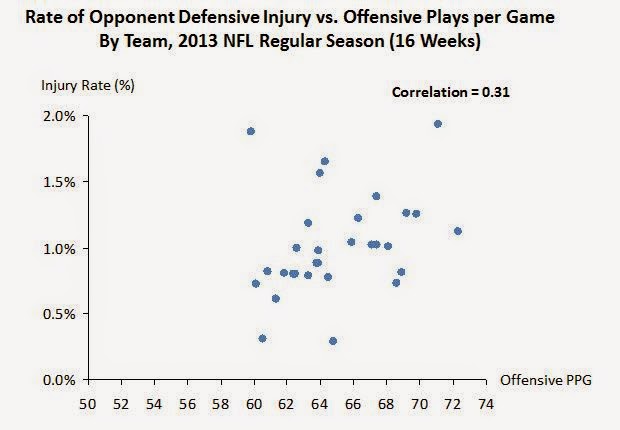
Now, below is the scatter plot that illustrates an offense's plays per game against its opponent's rate of injury. This had by far the most significant correlation of all the game situations we examined - and it's the only situation where teams would benefit from faking injuries.

So we saw a correlation of 0.39 - whereas other game situations didn't have anything close to that high.
How about 2013?

Once again, a pretty interesting positive correlation.
And, as in the 2014 analysis, there was nothing close to a similar correlation in the other game scenarios.
So now we have two years of analysis, both of which show the same patterns in the data.
When teams run more offensive plays, the defenses they face need injury stoppages more frequently.
Either you attribute this to defenses being out of shape/unprepared and thus more likely to get fatigued and hurt...or you're like me and assume on the margins some players fake an injury occasionally to get a breather.
I'm willing to listen to arguments for the former, but I'd say if you think Bill Belichick hasn't thought about it, that seems unlikely
- Defenses appear to suffer more in-game injuries than offenses
- Injury stoppages occur more as the game goes on, with the fourth quarter having the greatest frequency of injury stoppage
- There is a positive correlation between offenses which run more plays and opposing defenses suffering injuries - but no such correlation between play frequency and injury in any other game situation
To me, this at least suggests the possibility that defensive players fake injuries against high-tempo offenses. It certainly doesn't prove it, but when I finished looking at 2014, I wondered, did this hold across other seasons as well?
I had 16 weeks of play by play data from 2013, so I decided to look at that as well and see if what I saw in 2014 was an anomaly.
You can be the judge.
Below is an image from my last post, the frequency of injury stoppages by offense/defense and quarter:

Now, here's the same chart, but for my 16 weeks of the 2013 regular season

I'd say those are similar! We observe the same pattern, injuries increase as the game goes on, and almost entirely on the defensive side of the ball.
Now, below is the scatter plot that illustrates an offense's plays per game against its opponent's rate of injury. This had by far the most significant correlation of all the game situations we examined - and it's the only situation where teams would benefit from faking injuries.

So we saw a correlation of 0.39 - whereas other game situations didn't have anything close to that high.
How about 2013?
Once again, a pretty interesting positive correlation.
And, as in the 2014 analysis, there was nothing close to a similar correlation in the other game scenarios.
So now we have two years of analysis, both of which show the same patterns in the data.
When teams run more offensive plays, the defenses they face need injury stoppages more frequently.
Either you attribute this to defenses being out of shape/unprepared and thus more likely to get fatigued and hurt...or you're like me and assume on the margins some players fake an injury occasionally to get a breather.
I'm willing to listen to arguments for the former, but I'd say if you think Bill Belichick hasn't thought about it, that seems unlikely
Subscribe to:
Posts (Atom)